JCARM has migrated to a new Digital Publishing System (OJS) for enhanced indexing and metadata. [Click here to visit our new portal]
Peer Review Policy
The Gold Standard of Scholarly Integrity
At the Journal of Contemporary Academic Research and Methodologies (JCARM), we believe that rigorous peer review is the bedrock of academic progress. Our review framework is designed to be impartial and efficient, ensuring that every manuscript published under the Ivory & Finch imprint meets the highest global standards of methodological excellence.
JCARM utilizes a Double-Blind Peer Review model. In this process:
The identities of the authors are concealed from the reviewers.
The identities of the reviewers are concealed from the authors.
This ensures that every submission is evaluated solely on its scholarly merit, original contribution, and methodological soundness, eliminating bias and upholding the prestige of our multidisciplinary discourse.
Our Review Model: Double-Blind Integrity
Ethical Compliance
Our editorial board and review panel strictly adhere to the COPE (Committee on Publication Ethics) Guidelines. We are committed to identifying and preventing research misconduct, ensuring that JCARM remains a trusted repository for the international academic community.
The JCARM Review Timeline
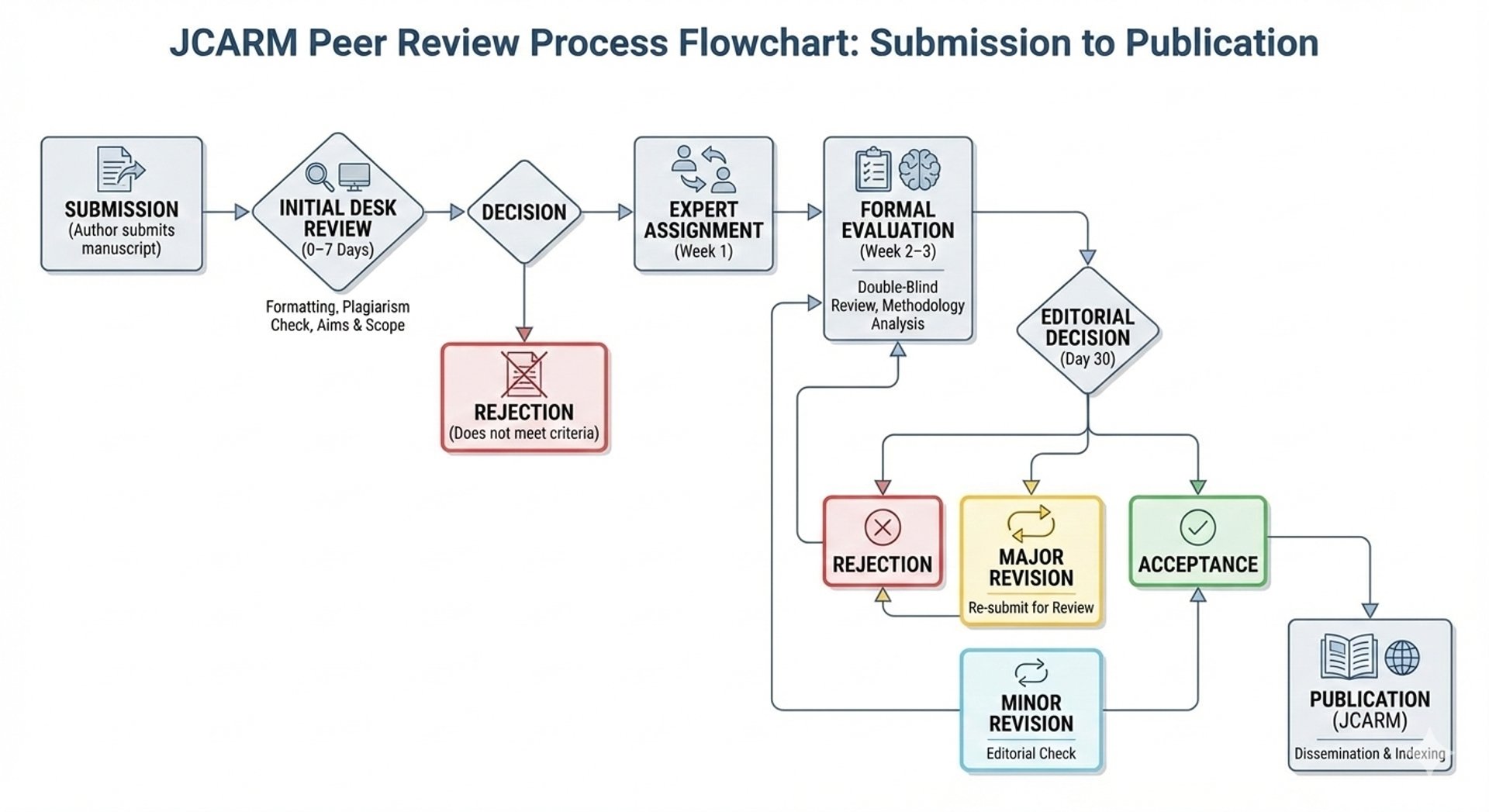
We recognize that in contemporary research, time-to-publication is vital. JCARM has optimized its workflow to provide a swift yet thorough evaluation:
Initial Desk Review (0–7 Days): Upon submission, manuscripts undergo an internal screening for formatting, plagiarism (using Turnitin/iThenticate), and alignment with our Aims & Scope.
Expert Assignment (Week 1): Qualified reviewers with expertise in the specific discipline are invited to evaluate the work.
Formal Evaluation (Week 2–3): Our reviewers analyze the manuscript’s methodology, data integrity, and contribution to the field.
Editorial Decision (Day 30): Authors receive a formal notification. Decisions include: Acceptance, Minor Revision, Major Revision, or Rejection.
Information for Reviewers
Our reviewers are selected based on their academic standing and publication history. We provide our reviewers with clear rubrics to ensure consistency across multidisciplinary submissions, focusing on the innovation of methodologies and the clarity of academic prose.
Publication Ethics & Malpractice Statement
Our Commitment to Integrity
The Journal of Contemporary Academic Research and Methodologies (JCARM) maintains the highest standards of publication ethics. Published by Ivory & Finch, we operate in strict accordance with the Committee on Publication Ethics (COPE) Core Practices. We expect all stakeholders—authors, editors, and reviewers—to uphold these principles of honesty and transparency.
Plagiarism Policy: Zero Tolerance
Academic originality is the hallmark of JCARM. To protect the integrity of the scholarly record:
Stringent Screening: All manuscripts undergo mandatory screening for unoriginal content using industry-standard software (Turnitin/iThenticate) upon submission.
Thresholds: A maximum similarity index of 10% is permitted, provided that individual sources are correctly cited.
Definition: Plagiarism includes the unreferenced use of others' ideas, data, or words, as well as "self-plagiarism" (re-publishing one's own previous work without proper disclosure).
Consequences: Any manuscript found to contain plagiarized material will be immediately rejected. If plagiarism is discovered post-publication, a formal retraction will be issued in accordance with COPE guidelines.
Conflict of Interest (COI)
To ensure impartiality, JCARM requires full disclosure of any financial, personal, or professional interests that could be perceived as influencing the research.
For Authors: Authors must declare all funding sources and potential conflicts of interest during the submission process. If no conflict exists, a "Statement of No Conflict" must be included in the manuscript.
For Reviewers: Reviewers must recuse themselves if they have a known professional or personal relationship with the authors or a vested interest in the research outcome.
For Editors: Editorial decisions are shielded from commercial influence and are based solely on the scientific merit and relevance of the work.
Ethical Treatment of Human and Animal Subjects
Research involving human participants, data, or animals must include a statement confirming that the study was approved by an Institutional Review Board (IRB) or an equivalent Ethics Committee. JCARM reserves the right to request proof of ethical clearance at any stage of the review process.
Data Integrity & Transparency
Authors are encouraged to maintain accurate records of supporting data and to provide access to such data if requested by the Editorial Board for validation purposes. Fabricating or falsifying results is considered a severe breach of ethical conduct and will result in a permanent ban from future JCARM publications.
Connect
Reach out with questions or submissions
Contact
Join Our Community
editor@jcarm.in
admin@ivoryandfinch.com
© 2025. All rights reserved.